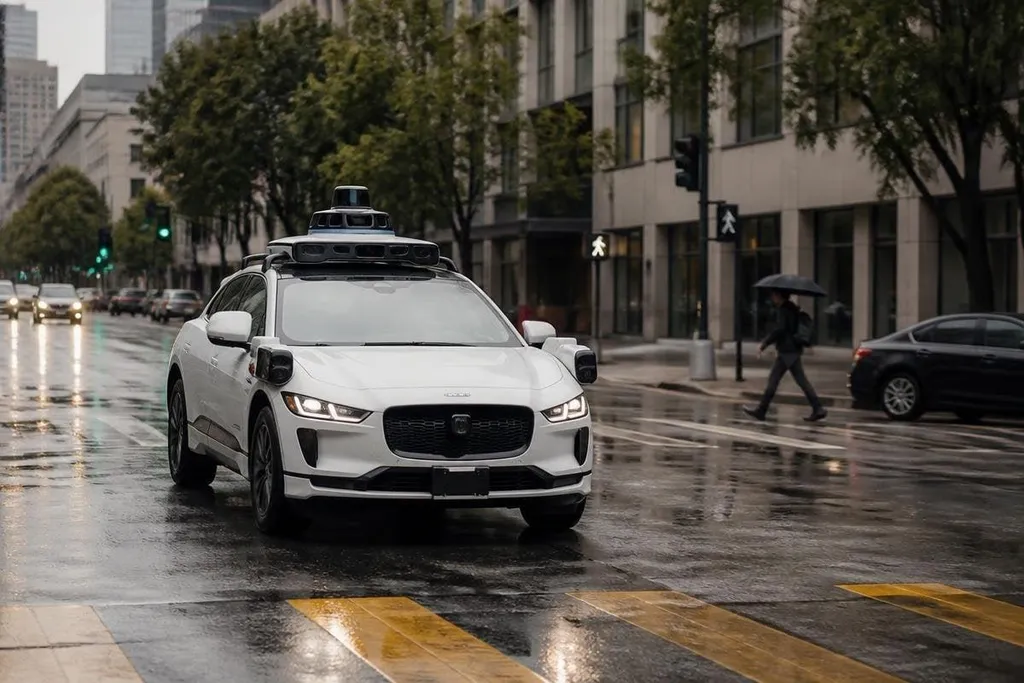
Self-driving technology has moved beyond the question of whether a car can steer itself. The harder test is whether it can make safe decisions across changing roads, weather, traffic rules, and human behavior.
Quick read
- Sensors collect different views of the road
- Software must predict what people and vehicles may do next
- Testing needs to cover rare failures, not only normal trips
Why self-driving is hard
A self-driving car makes a picture of its surroundings from cameras, radar, and LiDAR. Each sensor sees the road in a different way, so the software checks their readings before deciding what is nearby and what may move.
The car then has to predict events a few seconds ahead. A cyclist may change direction, a vehicle may stop without warning, or a road worker may guide traffic around a closed lane. The software has to pick a safe path while the scene keeps changing.
That work takes place under limits that a human driver may manage without noticing. Glare can affect cameras. Rain can reduce visibility. Road markings may be missing.
A map can describe a junction correctly one month and become wrong after construction the next. That leaves the car with a basic problem: its sensors and maps must agree with the road in front of it.
The race is about operating conditions
A self-driving system may run well inside a mapped area with clear weather and moderate traffic. That does not prove it can manage every road a driver may meet. The useful question is narrower: where can the system operate, and what happens when conditions leave that area?
This is why companies use operating limits, often called an operational design domain. The limit can include road type, speed, weather, location, and time of day. A car that drives itself on a fixed route in good weather has a different task from one expected to manage a city without a fixed route.
Those limits make the source behind each claim matter. Autonomous vehicle reporting from Robot24.com can place a car’s route, weather limits, test date, and safety driver beside the result, so you can check what happened before a rare event exposes the system’s weak point.
The missing test is the rare event
Normal driving gives a system many repeated examples. Rare events are harder. A fallen object, an unusual road layout, or a person behaving outside the expected pattern may appear too infrequently for ordinary road miles to cover well.
Simulation can make more of these cases, but a simulated result still depends on how closely the virtual world matches the road. Closed-course tests add control and repeatability, while public-road tests expose the car to natural variation. Each method tests a different question.
Safety also depends on what happens when the system cannot decide. It needs a clear handoff plan, enough warning for a human to respond when a human is part of the system, and a safe way to slow or stop when no handoff is available.
Why a global race needs common measures
Different teams may report different results because they test different roads, weather, traffic levels, and human supervision. A high number of autonomous miles tells little without knowing how many trips required help and what counted as a successful run.
A fair comparison needs shared definitions. It should record the operating area, weather, road type, intervention rate, collisions, near misses, and system failures. It should also explain whether a remote operator helped during difficult moments.
The same rule applies to public demonstrations. A short clip records one completed task. It doesn't reveal how often the system fails, how it reacts to an unexpected event, or how much human support sits outside the camera view.
A practical test for self-driving claims
Use these checks when a company presents a new result:
- Define the area: Ask which roads and locations the system can manage.
- Check the weather: Find out whether rain, snow, glare, or darkness were included.
- Count human help: Look for intervention data, remote support, and handoff rules.
- Study rare cases: Ask how the team checks unusual objects, road layouts, and behavior.
- Compare like with like: Match road type, speed, traffic, and test conditions before comparing results.
I’d rate any self-driving claim by its limits before its headline result. The technology can move people with less direct control, but public trust will depend on clear evidence about the moments when the system cannot cope.
The race will be settled less by a single flawless drive than by who can measure failure, explain the limits, and cut the number of unsafe decisions on ordinary roads.